
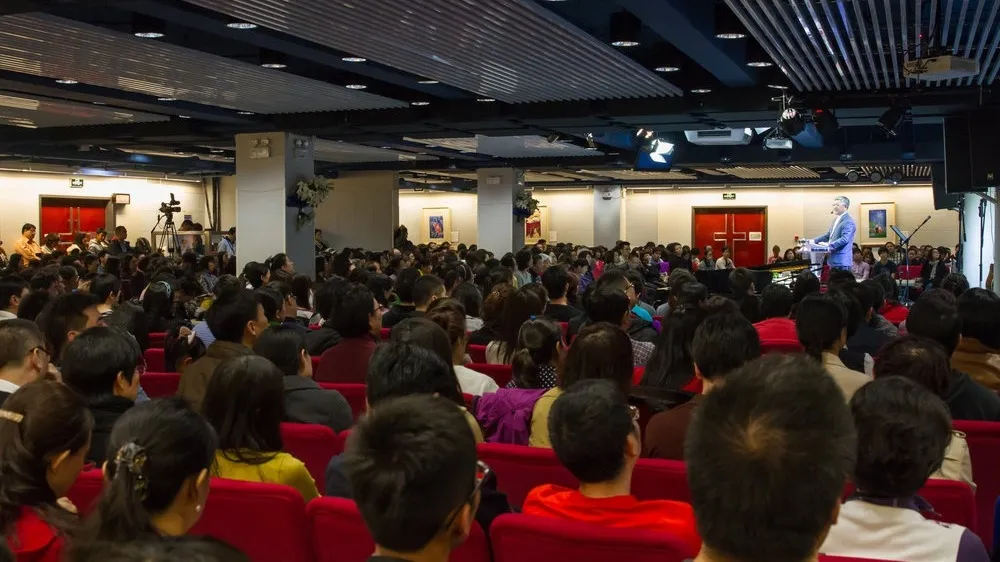
Beijing’s nationwide wave of raids on independent churches marks an escalation in the CCP’s war on faith unseen since the days of Mao’s Red Guards
北京对独立教会展开的全国性突袭,标志着中共对信仰的战争进入了自毛泽东“红卫兵时代”以来前所未见的升级阶段。
By Bob Fu (作者:傅希秋)
Oct 28th,2025 (2025年10月28日)
When police stormed homes across nine provinces on the night of Oct. 9, 2025, it marked more than just another chapter in China’s decades-long persecution of faith. It was the beginning of what human-rights observers are now calling the most sweeping coordinated crackdown on Christianity since the Cultural Revolution of the 1960s. The target: Beijing’s Zion House Church, the largest and most influential urban house church network in China’s modern history.
For 40 years, since the end of Mao Zedong’s bloody Cultural Revolution, China’s unregistered Protestant and Catholic congregations have operated in a precarious gray zone—technically illegal but often tolerated. That uneasy equilibrium shattered in October.
Zion Church’s founder and senior pastor, Rev. Mingri “Ezra” Jin, was taken from his home in Beihai, Guangxi Province. Within hours, police swept through multiple cities, arresting at least 22 pastors, preachers, and lay leaders, including Pastors Wang Cong, Yin Huibin, Liu Zhenbin, and Sun Cong. Two detention centers in Beihai now hold 13 women and nine men; others have been placed under house arrest or disappeared into China’s labyrinth of “residential surveillance” facilities.
The scale of this campaign is staggering. Zion Church was not a small underground fellowship. It was a sprawling network of more than 5,000 members across 40 cities and roughly 100 congregations, sustained by an online devotional program that attracted more than 10,000 daily participants before its digital presence was erased by authorities.
The message to Catholics is this: ‘Submit to the party’s “patriotic” authority, as sanctioned by Rome.’ The message to evangelicals is ‘Disappear.’
By any measure, Zion was China’s most dynamic Protestant Christian movement—a living symbol of how urban believers, professionals, and intellectuals could build a nationwide spiritual community outside the Communist Party’s control. It is precisely this vitality, observers say, that provoked the party’s wrath.
While Beijing’s hostility toward religion is nothing new, this 2025 Zion Church crackdown marks a dramatic escalation in method and intent. Unlike earlier campaigns that relied on localized harassment or selective arrests, this new wave was centrally planned and nationally synchronized—evidence of direction from the highest levels of the Ministry of Public Security and the United Front Work Department.
During the Cultural Revolution, the party sought to eliminate all religious expression as “superstition.” But under Xi Jinping, the persecution has taken on a more sophisticated, ideological character—what he calls the “sinicization of religion.” Churches are not merely destroyed; they are forced to submit, to rewrite Scripture, to display portraits of Xi alongside crucifixes, to teach loyalty to the party before loyalty to Christ.
This crackdown thus represents a return to Maoist absolutism cloaked in modern technology. Surveillance cameras monitor house gatherings. Artificial intelligence scans sermons for “illegal religious content.” Christian WeChat groups are infiltrated by state security. The party has learned that total control in the digital age requires both coercion and algorithmic precision.
Zion’s pastors faced not only raids but also digital erasure. Their online platforms—where believers once gathered for prayer, theological training, and humanitarian coordination—were deleted overnight, their bank accounts frozen, and lawyers threatened. Even the church’s elderly volunteers were interrogated about “foreign connections.” This holistic attack—physical, digital, psychological—marks a new stage of total repression unseen since Mao’s Red Guards smashed church altars six decades ago.
Zion Church’s growth terrified the party for one simple reason: It represented a self-organized, educated, urban faith community beyond state control. Its congregants included scholars, business leaders, artists, and young professionals. It was not a rural sect hiding in the mountains, but a thriving network in the heart of China’s cities.
In Beijing alone, Zion drew crowds of hundreds to its Sunday worship before its 2018 ban. That year, Pastor Ezra Jin refused to register with the government’s state-run Three-Self Patriotic Movement, insisting that Christ alone—not the party—was head of the Church. “To be registered under the state,” he said, “is to surrender the soul of the gospel to Caesar.”
That defiance made him a marked man. Since 2018, authorities repeatedly sealed Zion’s rented venues, cut power to its offices, and harassed its members. Yet the movement only grew—underground, decentralized, and digitally connected. By 2025, it had become a model for China’s independent urban churches. Crushing Zion was thus meant to send a message to all others: No spiritual movement shall exist outside the party’s shadow.
While the Zion case exposes the ferocity of the campaign that specifically targets evangelical Protestants, Beijing’s persecution of independent Catholics follows a different logic. Since the 1950s, the regime has maintained a dual-church system: the state-controlled Chinese Patriotic Catholic Association, which answers to the party, and the underground Catholic Church, loyal to Rome.
Evangelical churches like Zion are decentralized, often led by pastors with theological training from seminaries abroad or online. Their leadership is local, and their networks are agile—qualities that make them harder to control. Hence the state’s strategy has been to decapitate the leadership: arrest the pastors, cut off digital communication, and sow fear through intimidation.
In contrast, persecution against independent Catholics has focused on co-optation rather than elimination. The 2018 Vatican-China agreement, advanced by Pope Francis, marked a unprecedented degree of cooperation between the Catholic Church in Rome and the CCP. The agreement allowed the Communist Party to appoint bishops with papal approval, effectively bringing much of the Catholic hierarchy under state supervision. Those who refused this Papal compromise—like the underground Bishop Joseph Zhang Weizhu of Hebei or Cardinal Joseph Zen of Hong Kong—face house arrest, censorship, and isolation by the regime.
The message to Catholics is this: “Submit to the party’s ‘patriotic’ authority, as sanctioned by Rome.” The message to evangelicals is “Disappear.”
The persecution of Zion Church is not just a Chinese tragedy; it is a test for the conscience of the free world. It challenges democracies to decide whether they will treat religious freedom as a universal human right or a negotiable trade concession. It is no accident that the party targets believing Christians who insist on the integrity of their faith outside party control. The CCP sees freedom of conscience as a Western value that is incompatible with one-party totalitarian control, and thus targets Christians both for their religious practices and for their connection to the West and its values.
In justifying the Zion arrests, Beijing accused the church of “illegal dissemination of religious content via the internet” and “fraud”—charges commonly used to criminalize unregistered worship. But behind those legal fictions lies the same authoritarian impulse that built the digital firewall and interned over a million Uyghur Muslims and Christians in Xinjiang.
The timing of this campaign—just weeks before the Asia-Pacific Economic Cooperation (APEC) Summit in Seoul—cannot be ignored. It is a deliberate show of power, a message from Xi Jinping to the world: We fear no criticism, and we will crush every independent conscience to maintain our totalitarian system under the direction of the Communist Party.
As President Donald J. Trump prepares to meet Xi Jinping on Oct. 30 during the APEC Summit, the moral stakes could not be higher. In his first term, President Trump made historic strides by declaring China’s atrocities in Xinjiang a genocide and prioritizing global religious freedom. Now, the American president is faced with a new opportunity to speak with moral clarity about the persecution of Christians and America’s foundational values.
President Trump must urge Xi Jinping—publicly and unequivocally—to release all Christian prisoners of conscience, including Pastor Ezra Jin, Pastor Wang Yi, Pastor Yang Rongli, and the legendary Christian human-rights lawyer Gao Zhisheng, who remains missing after years of torture and house arrest. He should also call for freedom for countless Catholic clergy, Tibetan monks, and Falun Gong practitioners languishing in China’s prisons.
The CCP fears Christianity not because it threatens political stability, but because it undermines the party’s monopoly on truth. The Christian gospel teaches that the ultimate authority belongs to God, not to any earthly ruler. That single idea is intolerable to a regime built on absolute ideological control.
Zion Church’s rapid growth is living proof that faith flourishes even under oppression. Its believers did not seek political confrontation—they sought spiritual renewal. They built community, charity, and hope in the heart of China’s cities. Yet to Xi Jinping, even hope is subversive if it does not bow to the party.
In the coming weeks, global attention will turn to Seoul and the APEC Summit. But long after the cameras fade, the question will remain: Can Xi Jinping’s war against faith succeed where Mao’s failed? History answers clearly: no.
When Mao declared religion “poison,” churches went underground but never vanished. When Bibles were burned, believers hand-copied Scripture by candlelight. When pastors were jailed, new ones rose to take their place. The blood of martyrs became the seed of revival.
Today, that same faith endures. Despite mass arrests, believers in Zion Church continue to meet quietly in homes and online under pseudonyms. Their courage exposes the bankruptcy of the Communist Party’s ideology. You can jail pastors, but you cannot jail the gospel.
Since his arrest on Oct. 10, Pastor Ezra Mingri Jin managed to send a single note through his lawyer—a message now circulating among Christians worldwide. It contained only two words, written in capital letters: “FEAR NOT.”
Those words echo through centuries of persecution—from the Roman catacombs to China’s modern prisons. They remind believers and tyrants alike that no power on earth can extinguish the light of conscience.
As Jesus said, “Do not fear those who kill the body but cannot kill the soul” (Matthew 10:28). And as church history—from Acts to modern China—has shown, every empire that wages war against God’s people ultimately wages war against itself.
President Xi would do well to remember this truth: Your war against God will fail. The Church of Christ in China will prevail. For it is written, “The light shines in the darkness, and the darkness has not overcome it” (John 1:5).
We look to President Trump, to Vice President JD Vance, and to American Christians to speak loudly and clearly in defense of the right of fellow Christians to freely practice our faith, as an expression of America’s own values—which will hopefully stand in sharp contrast with the values and behavior of China’s corrupt and oppressive communist regime.
一、全国突袭:新一轮文化大革命式的镇压
2025年10月9日晚,警察在九个省份同时闯入家庭住宅。这不仅是中国几十年来信仰迫害的又一章,而是被人权观察者称为自上世纪六十年代文化大革命以来,最广泛、最系统的基督教大镇压的开始。
目标:北京锡安教会——中国当代历史上最大、最有影响力的城市家庭教会网络。
自毛泽东血腥的文化大革命结束以来,长达40年的时间里,中国未注册的基督教新教与天主教群体一直在“灰色地带”中生存——在法律上不被承认,但在某种程度上被容忍。然而,这种脆弱的平衡在今年十月彻底被打破。
锡安教会的创办人兼主任牧师金明日(Ezra Jin)在广西北海被捕。数小时内,警方在多个城市展开突袭,逮捕至少22位牧师、传道人和同工,包括王聪、尹会彬、刘桢彬、孙聪等牧者。北海的两处看守所目前关押着13名女性与9名男性,其他人则被软禁或消失在中国庞大的“指定居所监视居住”体系中。
二、教会的成长与中共的恐惧
锡安教会并非地下小型团契,而是一个横跨40个城市、约百个会众点、超过5000名成员的庞大网络。其线上每日灵修节目吸引超过万人参与,直到当局一夜之间试图彻底抹去其网络存在。
锡安教会象征着城市知识分子、专业人士与信徒如何在共产党的掌控之外建立属灵共同体。正因其自发、自主、充满活力的特性,引发了当局的恐惧与愤怒。
三、中央指令的全国性行动
虽然中共对宗教的敌意早已众所周知,但此次2025年对锡安教会的打压,在规模与意图上均显著升级。与以往局部骚扰或个别抓捕不同,此次行动由公安部与中共中央统战部高层统一策划、全国同步执行,显示这是来自最高层的政治命令。
毛泽东时代以“破除迷信”为名试图根除宗教;而在习近平时代,迫害则披上了“宗教中国化”的意识形态外衣。教堂不仅被拆毁,更被迫改造:圣经需重写,十字架旁要挂习近平像,讲台上必须宣讲“党比基督更高的忠诚”。
四、科技极权与“数字消灭”
这场镇压是毛式极权与现代科技结合的产物。
监控摄像头记录家庭聚会,人工智能扫描讲道内容是否“违法”,微信群被国安人员渗透。
锡安教会牧者不仅遭突袭,也被“数字抹除”:他们的平台、奉献账户被封锁,律师遭威胁,连老年志工都被审讯“有无境外关系”。
这是一场全面、物理与心理并行的灭绝式攻击——自红卫兵砸毁祭坛以来未曾见过。
五、信仰的火种:为何锡安教会触怒中共
锡安教会的信徒多为学者、商界人士、艺术家与青年专业人士——他们不是偏远山村的秘密团契,而是城市中心蓬勃发展的信仰群体。
2018年以前,教会每主日聚会吸引数百人。那一年,金明日牧师拒绝加入党国家“三自爱国运动”,宣称:“若将教会置于国家之下,就是把福音的灵魂交给凯撒。”
正是这种拒绝“属灵投降”的姿态,使他成为中共眼中的眼中钉。
六、打压的不同逻辑:新教与天主教
锡安案显示中共针对福音派教会的暴力,而对独立天主教的策略则是“收编”。
自1950年代起,中共就建立了“双轨体制”:一是党控的中国天主教爱国会;二是效忠罗马的地下教会。
2018年梵中协议使共产党获得任命主教的权力,将大部分教阶体系纳入党控结构。拒绝此妥协者,如河北张维柱主教与香港陈日君枢机,皆遭软禁与噤声。
因此,天主教徒的信息是“向党低头”;福音派的信息则是“彻底消失”。
七、全球的考验:信仰与自由的边界
锡安教会的迫害,不仅是中国的悲剧,更是自由世界良知的试炼。
它迫使民主国家面对一个问题:宗教自由究竟是普世人权,还是可以交易的外交筹码?
北京以“非法传教”“诈骗”等罪名为逮捕辩护,但这些都是用来掩盖独裁本能的法律幌子——正如防火长城与新疆集中营背后的逻辑一样。
这场镇压恰逢首尔APEC峰会前夕,是习近平向世界展示权力的宣告:“我们不惧批评,我们要消灭一切独立良心。”
八、自由世界的呼声:呼吁川普总统发声
当美国总统唐纳德·J·川普于10月30日在首尔会晤习近平时,全球的道德焦点将再次聚集。
在首任期内,川普曾认定中共在新疆的暴行构成种族灭绝,并将宗教自由列为核心外交议题。如今,他再次面对一个历史性时刻——是否能以道德清晰的声音为被囚的信徒发声。
他应公开敦促习近平释放所有因信仰被捕的基督徒良心犯,包括金明日牧师、王怡牧师、杨荣丽牧师,以及长期失踪的维权律师高智晟;同时要求释放被囚的天主教神职人员、西藏僧侣与法轮功学员。
九、结语:光照在黑暗中
中共惧怕基督教,并非因其威胁政权稳定,而是因为基督信仰挑战了党对真理的垄断。
基督教宣告终极权柄属于上帝,而非世上任何君王——这对建立在意识形态绝对控制上的体制而言,是致命威胁。
锡安教会的迅速成长再次证明:信仰即使在铁幕之下仍能兴旺。信徒并非追求政治抗争,而是属灵更新;他们在城市中建立社群、怜悯与盼望。
但在习近平眼中,哪怕是“盼望”,若不向党俯首,也属颠覆。
十、信仰不灭:惧怕的人是暴政,不是教会
即使遭大规模抓捕,锡安教会的信徒仍在暗中聚会、线上交流。他们的勇气揭示了共产党意识形态的空洞:你可以囚禁牧者,却无法囚禁福音。
自10月10日被捕后,金明日牧师透过律师传出一张纸条——仅有两个大写词汇:“FEAR NOT(不要惧怕)。”
这回响穿越千年,从罗马地穴到中国的监狱。正如主耶稣所言:“那杀身体不能杀灵魂的,不要怕他们。”(马太福音10:28)
历史一次又一次地证明:每一个与上帝子民开战的帝国,最终都在与自己为敌。
习近平若有智慧,当铭记此真理:你可以向神开战,却必然失败。因为“光照在黑暗里,黑暗却不胜光。”(约翰福音1:5)
我们呼吁川普总统、副总统万斯以及全体美国信徒——为受迫害的中国教会发出清晰的声音,捍卫信仰自由这一根本价值,让美国的信念与中共腐败暴政的黑暗形成鲜明对比。
作者简介:
傅希秋博士是国际知名的中国宗教自由与人权倡导者,
对华援助协会(ChinaAid)创办人兼会长(成立于2002年)。
著有《上帝的双面特工》(2013)与《共产中国虚幻的宗教自由:包容多元的政治方能有效实现》(英文版2020;中文版2025)。
现任美国家庭研究委员会宗教自由中心高级研究员,
并曾多次在美国国会、联合国、英国、荷兰与台湾国会作证。
本文原载经作者授权转发。
捐款方式:(请注明您的姓名和电邮,以便我们寄送收据):
1)Zelle: nacr2021@gmail.com
2)PayPal: PayPal.me/NAConservative1
3)支票抬头:NACR 地址:1951 McConnor Blvd, #59169 Schaumburg,IL 60159
敬请订阅:
《北美保守评论 – YouTube新频道》:https://www.youtube.com/channel/UCXD6cjPFfBLlQMlSJi6h_6g
《北美保守评论 – Rumble频道》: https://rumble.com/user/NACR2021
《北美保守评论》电报(Telegram)时评文章频道:https://t.me/NAconservative
《北美保守评论》电报(Telegram)翻译视频频道:https://t.me/VIDEOSBYNACR
《北美保守评论》电报(Telegram)交流群:https://t.me/+92XsKo9C-upmZTRh
《北美保守评论》推特(Twitter):https://mobile.twitter.com/naconservative9
《北美保守评论》脸 书(Facebook):https://www.facebook.com/100052658047986
《北美保守评论》Gab: @NACR :https://gab.com/NACR
川普的真相社交(TruthSocial):https://truthsocial.com/@NACR